The power of
emptiness.
Negative space as a strategic weapon. Three principles to let your compositions breathe and amplify the message.
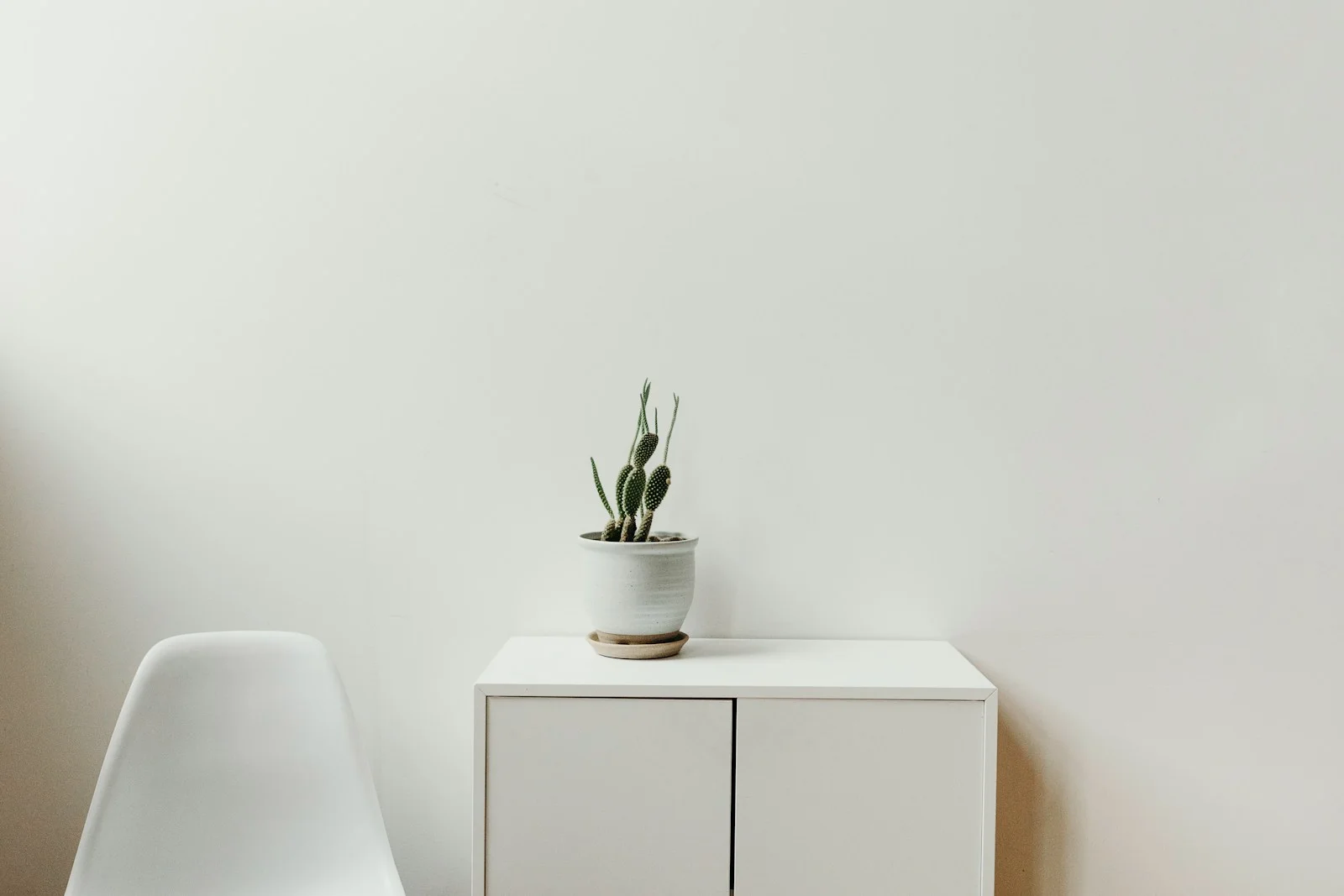
Most designers want to fill. More text, more images, more colours, more features. But the best studios in the world do exactly the opposite: they take away. They leave emptiness. And it is precisely that emptiness that gives everything else its power.
As a communication agency, we encounter this tension in every brief. The client wants to "say everything". Our job is often to convince them of the opposite: don't say everything, so that the essential is heard more clearly.
Negative space is not emptiness
We call it "white space", "whitespace", "negative space". These terms are misleading. Negative space is not absent — it IS the work, just as much as the central element. It is a raw material of design, not an absence.
When you look at an Apple logo, the first thing you see is not the apple. It is the space around it. When you read a well-set book, it is not the text that draws you in — it is the margin. When you walk into an Hermès boutique, what strikes you is not the quantity of products. It is their rarity within the space.
"Silence is part of the music. Negative space is part of design."
Principle 01 — Emptiness is a promise
A luxury magazine devotes 60 to 70% of every page to negative space. Vogue, the Apple Stores, the shop windows of Saint-Honoré — all apply the same implicit rule: what you leave unoccupied is worth more than what you fill.
Luxury is measured in unused square metres. When you make your design more open, you send a silent signal: "what is here matters — so we give it room". Conversely, an overcrowded layout whispers: "everything is the same, nothing is essential".
Principle 02 — Emptiness guides the eye
The human brain does not read linearly. It scans in leaps. And what determines the path of the gaze is not the content — it is the space between the content.
Place ten tightly packed elements on a page: the eye doesn't know where to look. It wanders, hesitates, gives up. Place those same ten elements with breathing room between them: the eye naturally follows an F- or Z-shaped reading pattern. Negative space is invisible art direction.
In our layout and graphic composition projects, we spend as much time choosing where to put nothing as choosing where to put something. The two decisions matter equally.
Principle 03 — Emptiness intensifies emotion
A cry in silence is louder than a cry in noise. A single photograph on a white background hits harder than a photograph in the middle of a collage. A lone headline across a double-page spread intrigues more than ten stacked slogans.
Negative space does not reduce impact — it concentrates it. It is an emotional magnifying glass. Everything placed within it gains gravity, intensity, memorability.
"Less is more — only when more is much less."
Three cases that prove it
- The FedEx logo — the space between the "E" and the "x" forms a hidden arrow. No one sees it consciously, yet everyone senses it. Emptiness conveys an idea that colours and letters could never have carried.
- Apple's typographic system — line-height at 1.5×, minimum letter-spacing at 0.5em, very generous margins. Space everywhere: between letters, between lines, between blocks. This is what creates the feeling of technological luxury without a word being said.
- The architecture of the Centre Pompidou — the revolution is not in the visible structure. It is in the great central void that welcomes the visitor. The building says: slow down, you have arrived.
Three common mistakes
- Confusing emptiness with a blank page. If you don't know why you are leaving space, it isn't intentional — it is simply absent. That difference is everything.
- Wanting to fill "because there's room left". The room that is left is the room that speaks. If you fill it by default, you silence the most effective voice in your layout.
- Shrinking space to fit in more content. You aren't just reducing space — you are also reducing the perceived value of every element. Mathematically, more content without more space = less attention per element.
How to apply it from tomorrow
- Multiply your margins by 1.5× whatever you first thought was necessary.
- Increase line-height to 1.6 or 1.8 for body text — especially above 16px.
- Double the space between sections. The reader will better understand what belongs to what.
- When in doubt whether to remove or add: remove. You will rarely go back.
- Print it out and step back a metre. If the composition holds at one metre, it will hold at one and a half.
In short
Negative space is the most underrated weapon in graphic design. It costs nothing to produce, takes no extra time, requires no sophisticated software. It demands only courage: the courage to forget the urge to fill, and to trust the eye of the person receiving it.
The more you take away, the more irrevocable what remains becomes. This is the central paradox of design: rarity is what makes things visible.